Canada-based hi-fi manufacturer NAD has announced a new stereo amplifier with high-res audio streaming capability and an HDMI eARC port for hooking up to a 4K TV. The announcement arrives in advance of next week’s High End Munich show, an audiophile’s paradise that draws hi-fi fanatics from all over the world.
NAD’s C 3050 is a follow up to a limited edition version of the same amp the company released back in late 2022. Produced in a run of 1,972 numbered units to commemorate NAD’s 50-year anniversary, that model seemed like a sort of trial balloon to see how hi-fi fans would respond to the amp's retro design.
The test run was clearly a success, because owners of the best stereo speakers quickly bought up the limited edition C 3050. Now, NAD’s amp is being made widely available, and is priced at a not-outrageous $1,399 (around £1,125 / AU$2,100).
The C 3050's return is good news, mainly because with its chunky buttons and control knobs, glowing VU meters, and wood-finish casing, it's literally the best looking integrated stereo amp we know of. When it comes to hi-fi, retro design is a winning proposition, and the C 3050 hearkens back to the glory days of the ‘60s and ‘70s when brands like Marantz, Yamaha, and JBL made similarly cool-looking gear.
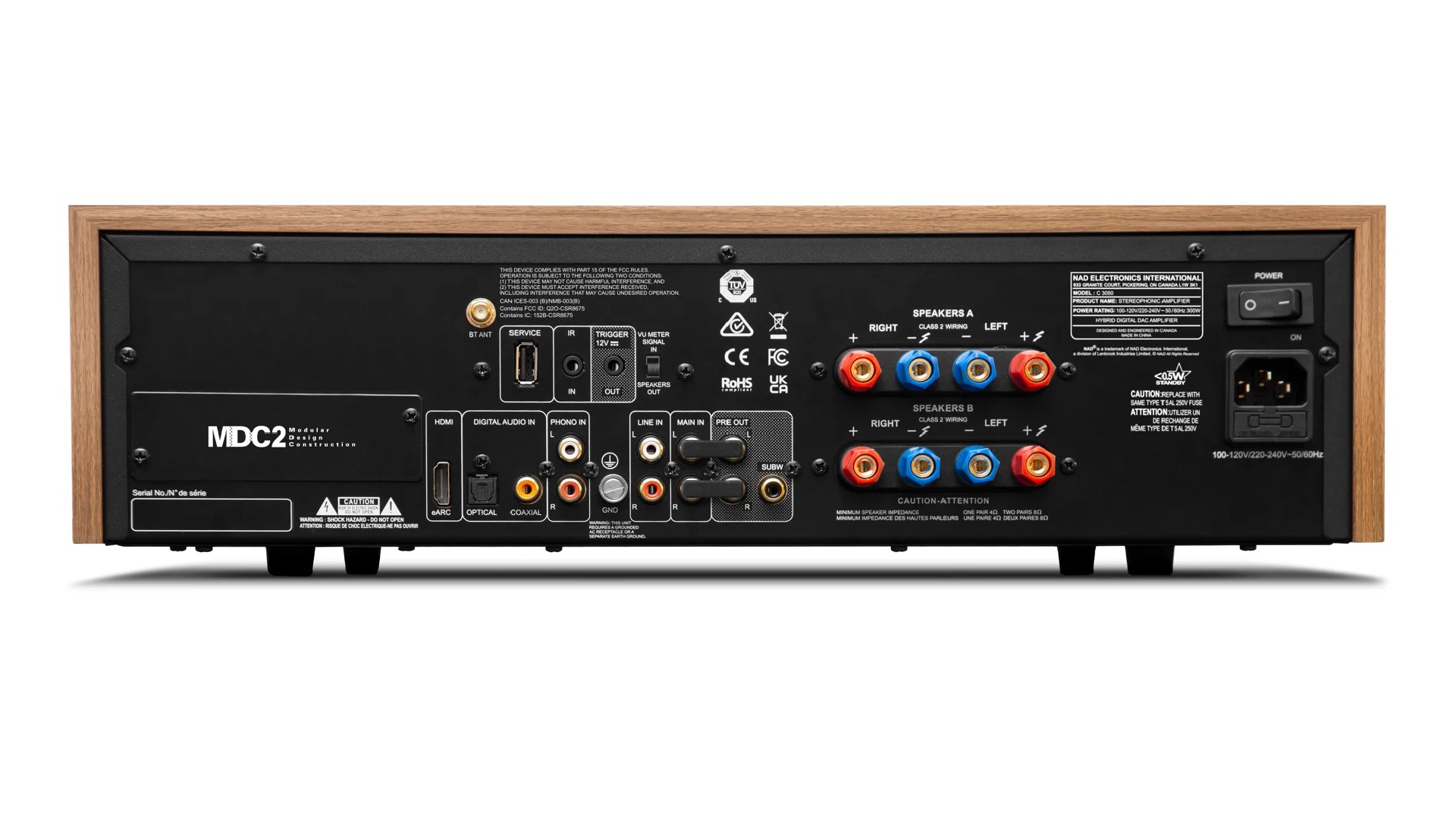
Looking past its retro exterior, the C 3050 is a fully loaded modern integrated stereo amp rated to deliver 100 Watts per channel into 8/4 ohms. It has both analog and coaxial and optical digital inputs, along with the aforementioned HDMI eARC port. A moving magnet phono stage lets you connect one of the best turntables, and there are dedicated subwoofer and headphone outputs plus a proprietary MDC2 slot to accommodate NAD’s MDC2 BluOS-D module ($599).
While the MDC2 BluOS-D module is an optional add-on, listeners will want to scoop that up as well in order to take advantage of the multiroom wireless high-res audio streaming capability it brings to the C 3050. This feature is controlled using the excellent BluOS app, and the MDC2 BluOS-D further supports Spotify Connect, Tidal Connect, and AirPlay 2, along with two-way aptX HD Bluetooth, which lets you stream audio to the amp and also use a set of the best wireless headphones for listening.
Another feature the MDC2 BluOS-D module brings to the table is Dirac Live. Dirac Live processing provides both time- and frequency-based room correction, and it covers not just bass but your speakers’ full frequency range.
Analysis: back to the retro future
Retro is all the rage in the hi-fi world, with a wide assortment of brands looking to their past for design inspiration. And while we can’t say we’re fully on board with some of the retro speakers we’ve seen (The JBL 4329P Studio Monitor Powered Loudspeaker being an exception), vintage-looking amplifiers like NAD’s C 3050 are deeply appealing.
The advent of music streaming services has made music listening something of a hands-off activity. Streaming with the best wireless speakers is controlled by apps, and many of them also support voice commands for an even more complete hands-free experience. That’s partly why vinyl records have made a comeback, and why retro components like the C 3050 with its big buttons and warm, engaging VU meters, are audio objects of desire – you want to physically interact with them, as opposed to letting Alexa do the work for you.
At the same time, when outfitted with NAD’s optional MDC2 BluOS-D module, the C 3050 provides all the mod cons such as wireless high-res streaming and room correction. It even supports Alexa, Google Assistant, and Siri voice commands if that’s something you want to engage with!
With one foot in the audio’s future and the other in audio’s past, the C 3050 is the kind of component that will help keep hi-fi alive and kicking. It’s a good thing that NAD opted to make more than 1,972 of them.
Comments